

Key Takeaways
- Unified Quality Intelligence: Have a single, consolidated view of quality performance across all delivery teams, replacing fragmented project metrics with shared measures of success.
- Continuous Operational Improvement: Move beyond identifying recurring bottlenecks and establish a repeatable cycle that turns insights into implemented fixes and measurable impact.
- Scalable Efficiency: Achieve consistent, predictable delivery across pods without slowing teams down with unnecessary operational complexity.
- AI and Automation Readiness: Ensure your underlying processes are mature and data-ready before scaling investments in test automation and AI agents.
In high-velocity development environments, consistency is often the first casualty of speed. When project teams focus exclusively on execution, systemic gaps in standards and processes can lead to unpredictable quality, rework, and a lack of transparency.
Even when engineering teams work hard, scaling organizations often hit invisible friction points:
- QA teams are delivering, yet leadership lacks a consolidated view of quality performance.
- Different projects use conflicting measures of success, making cross-team comparisons impossible.
- Pods repeatedly encounter the exact same quality and process bottlenecks.
- Improvement opportunities are identified during retrospectives, but rarely implemented consistently.
- Organizations invest heavily in automation and AI without knowing if their underlying processes are ready.
A modern quality management office (QMO) functions as an enablement engine. It helps organizations achieve consistent, measurable, and scalable quality, combining quality intelligence, operational excellence, and continuous improvement without adding unnecessary operational complexity.
Creating Visibility
💡 A QMO gives leaders and delivery teams a shared language for success, turning fragmented project data into actionable quality intelligence.
In many organizations, QA happens in silos—different teams use different standards, leading to inconsistent quality and fractured reporting. A Quality Management Office unifies these efforts by connecting quality data across teams, turning cross-project insights into shared benchmarks, executive visibility, and practical playbooks that help every team deliver with confidence.
The QMO remains structurally separate from delivery teams. Because the QMO sits outside day-to-day sprint pressures, it can connect the dots across projects. By aligning KPI definitions and metric catalogs, the QMO equips organizations with a consolidated view of quality performance while freeing delivery teams to focus on building.
The Continuous Quality Loop
💡 Identifying process gaps is easy; ensuring fixes actually stick across teams is what drives real operational excellence.
Inconsistent processes are a silent growth-killer. When reporting is not uniform, you lose the ability to measure success accurately, leading to a maturity plateau where teams prioritize speed over standards. Without a unified baseline for quality metrics, it is difficult to scale effectively.
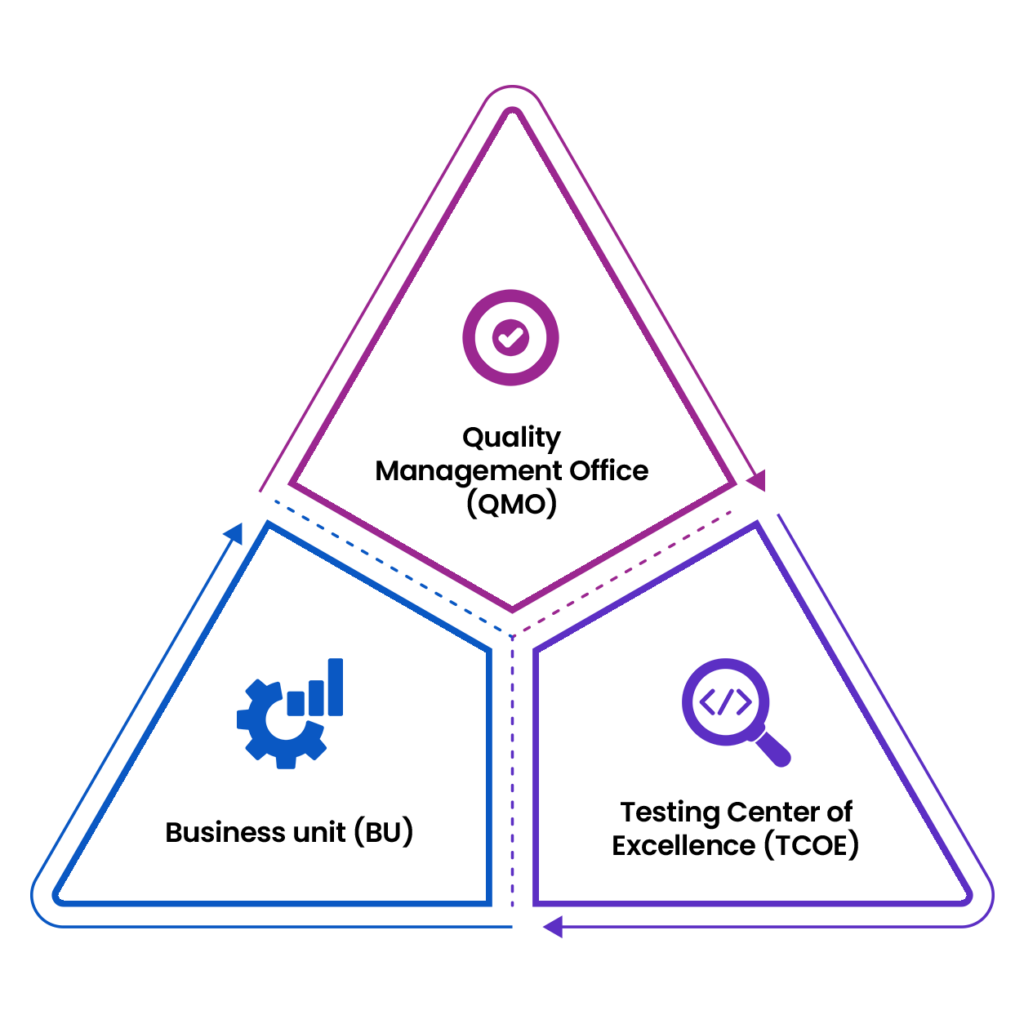
Instead of one-off audits, a QMO enables a continuous, closed-loop operating rhythm across the delivery lifecycle:
- Measure performance: Establish uniform metrics across pods to benchmark delivery health objectively.
- Identify opportunities: Spot recurring defect patterns, bottlenecks, and process gaps early.
- Enable improvements: Co-develop and implement practical playbooks, standards, and tooling with delivery teams to resolve root causes without disrupting sprint velocity.
- Validate impact: Track post-rollout outcomes to verify that changes actually improved velocity and quality, feeding fresh data back into the next cycle.
Because improvements are designed and rolled out in partnership with delivery teams, fixes actually stick, stopping teams from fighting the same fires sprint after sprint while providing reliable data for capacity planning and smarter budget allocation.
Evidence in Action
💡 Uniform standards eliminate the cycle of reworks, directly lowering the total cost of quality and accelerating release velocity.
The strategic value of a QMO is best demonstrated through real-world performance metrics. In an engagement with a fintech company, Stratpoint embedded QMO enablement into a testing-as-a-service (TaaS) model to validate critical multi-step, end-to-end, API, and cross-system workflows. 79% of automated test cases were classified as medium or high complexity, reflecting substantial engineering depth.

Delivery visibility and traceability: QMO enables consistent tracking of delivery commitments, progress, and outcomes across sprints.

Quality standards at scale: QMO supports consistent quality practices and visibility as testing complexity increases.

Performance accountability and continuous improvement: QMO enables transparent measurement of commitments and identification of improvement opportunities.
Building the Foundation for Automation & AI
💡 You cannot safely deploy AI on a broken process. A QMO provides the standardized, auditable baseline required for true engineering excellence in the age of AI.
Many organizations rush to invest in test automation and AI tools without knowing whether their underlying QA processes are ready to support them. You wouldn’t put a high-performance AI engine in a car with a broken chassis, and a QMO builds that chassis. Autonomous AI agents are only as capable as the environment they interact with, requiring clean data and repeatable, well-aligned processes to function reliably.
A QMO keeps your engineering ecosystem aligned and reliable, giving your organization the operational readiness to scale autonomous workflows tomorrow.
Why Stratpoint QMO?
💡 Stratpoint’s QMO model is built for velocity, embedding directly into your existing workflows to drive measurable improvements and AI readiness without slowing down delivery.
Stratpoint builds QMOs for modern engineering velocity, embedding practical enablement directly into how your teams already work:
- Delivery-integrated enablement: QMO works alongside existing QA delivery teams rather than adding a separate approval chain.
- Data-driven quality intelligence: Consolidated quality metrics inform both executive and operational decisions.
- Practical continuous improvement: Improvements are implemented and validated alongside squads, not merely recommended.
- Right-sized adoption: QMO can be introduced incrementally based on organizational maturity and scale.
- AI-Augmented QA alignment: Quality operations are prepared to support and measure emerging AI-enabled workflows.
Is your quality practice ready to scale from informal checks to institutional trust? Don’t leave your engineering excellence to chance. Transition from fragmented testing to a scalable, AI-ready quality engine. Book your QMO strategy session with #StratpointQA experts.
Further Reading
Download the Agentic Transformation Report to learn how modern software engineering and QA muscles turn raw AI capability into dependable production systems. Talk to our experts about evaluating your agentic readiness.