


Key Takeaways
How leading banks scale API governance without slowing innovation:
- Reduce Risk: Centralize IAM at the gateway to enforce least-privilege access
- Prioritize What Matters: Apply rate limiting after IAM to favor high-value partner traffic
- Enable Real-Time Compliance: Replace manual approvals with machine-readable policies
- Ensure Consistency at Scale: Use CI/CD and config-as-code to keep environments aligned
Financial services have evolved from centralized, monolithic core banking systems toward distributed, microservice-oriented architectures. As organizations increasingly rely on operational data platforms and central API integration layers to facilitate open banking and partner ecosystems, the complexity of managing these interconnections introduces significant operational risks and cost overheads.
Maintaining systemic integrity and ensuring audit compliance are no longer peripheral technical concerns but have become foundational requirements for institutional stability and regulatory standing. The modern banking environment demands a transition from viewing APIs as short-project deliverables to treating them as long-term products governed by rigorous, machine-readable standards and centralized identity frameworks.
Foundational Resilience: Centralized IAM
💡 Centralizing identity eliminates the high cost of fragmented security logic across microservices and ensures institutional stability by providing full traceability.
In managing operational data platforms and central API integration layers, the challenge is not just about connecting services, but also doing so without creating a compliance debt. Compliance today depends on proving that every system-to-service interaction is authenticated, authorized, and logged with full traceability.
Many banks focus on the perimeter but may overlook internal access control. This could lead to credential sprawl, where developers and services hold overly broad permissions or orphaned admin rights.
At Stratpoint, we advocate that centralized Identity and Access Management (IAM) should come first. Implementing this on the API gateway on day 1 offers an immediate reduction in operational risk by:

Streamlining the Joiner-Mover-Leaver process
When an employee or partners departs, access is revoked across every environment instantly, eliminating the risk of ghost accounts.

Implementing traceability
Every request should be traceable to simplify audits and ensure you can evolve access controls seamlessly.

Enforcing least-privilege by default
Every service, API, and automation gets its own unique identity with scoped permissions.

Reducing cost
Centralization removes the need for fragmented, custom-built security logic within every microservice.
Smart Sequencing: Rate Limiting After IAM
💡 By layering rate limits on top of IAM, banks can distinguish between routine internal calls and high-priority partner traffic, essential for open banking readiness and fair-use governance.
Many teams attempt to protect their infrastructure by applying global rate limits at the gateway. However, without an identity context in place, you cannot distinguish between a routine internal service and high-priority traffic from a partner ecosystem, a distinction vital for open banking readiness. Rate limits without IAM are blind. You are capping traffic without knowing who is consuming it.
By layering rate limiting on top of IAM, you gain the ability to enforce limits based on:
- Specific roles or systems: Prioritize high-value revenue streams and critical partner integrations over low-priority internal tasks.
- Environment context: Adjust limits dynamically based on whether the traffic originates from a trusted partner or a new integration.
Start with IAM to create structure, then layer rate limiting on top to manage traffic intelligently and ensure the platform is built for the scale and fairness required by an open financial ecosystem.
Policy-Driven Control: Speed Meets Compliance
💡 Embedding approval logic directly into the platform allows engineering teams to ship faster without waiting on manual infrastructure review loops.
The solution is policy-driven access control. By defining governance through reusable, machine-readable rules, access decisions are made automatically in real-time. This approach keeps the bank compliant without the bottleneck. By integrating an advanced gateway into the IAM layer, every API call is authenticated, and every access point is governed by policy. Teams can ship faster because the approval logic is already embedded into the platform.
Automation at the Gateway
💡 Automated gateway ensures that the exact state validated in staging is what is deployed in production, preventing environment drift that leads to system outages.
To maintain banking API integrity and audit compliance, every change to the integration layer must be versioned and traceable. Using automated gateway management tools like decK (command line tool for API lifecycle automation) and CI/CD pipelines allows for config-as-code. This means your API gateway state is always documented, reviewed, and deployed safely without manual intervention.
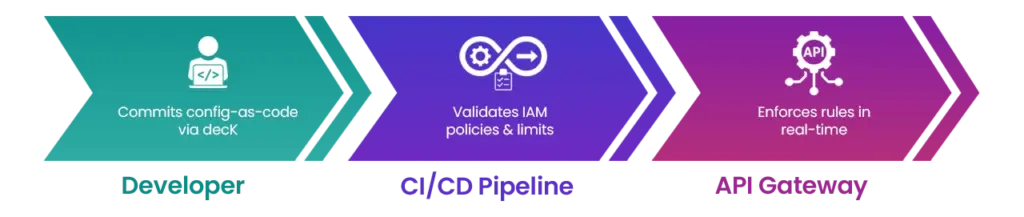
This flow provides peace of mind by preventing environment drift, keeping staging and production always synchronized. This synchronization ensures that what you test is exactly what you deploy, removing the fear of production failures due to manual configuration errors.
Establishing the Foundation
By starting with centralized IAM and moving toward policy-driven governance, banks establish the high-integrity habits required to satisfy regulators without trading off the speed of delivery. Ready to fortify your central API integration layer? Establish a scalable, policy-driven API foundation that is audit-ready and accelerates innovation. Fill out the form below to schedule a discovery call with #StratpointSoftware and #StratpointData experts.
Further Reading
Download the Agentic Transformation Report to learn how modern software engineering and QA muscles turn raw AI capability into dependable production systems. Talk to our experts about evaluating your agentic readiness.