
Mastering QA to build trust and resilience in Banking and Finance
Executive Summary
The banking and financial services industry in the Philippines is undergoing rapid digital transformation, driven by the growing adoption of online banking, mobile payments, and fintech solutions.
According to the Bangko Sentral ng Pilipinas (BSP), digital payment transactions accounted for 52.8% of monthly retail payments in the country by the end of 2023, surpassing the government’s target of 50% digital payment adoption. With this increasing reliance on digital financial services, ensuring the quality, security, and reliability of banking and fintech applications has never been more critical.
Digital Payment Adoption in PH
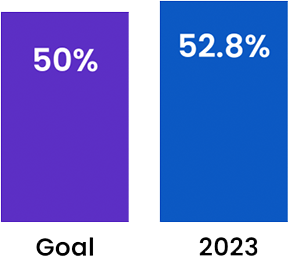
Based on the Digital Payments Transformation Roadmap 2018-2023
Quality assurance (QA) in banking and fintech applications is crucial for maintaining trust, preventing financial losses, and ensuring compliance with stringent regulatory requirements. In an environment where even a minor software defect can lead to fraudulent transactions, security breaches, or operational failures, robust QA practices are essential. The customers’ demand for seamless digital experiences further underscores the need for reliable and high-performing applications.
Why a Strategic QA Framework Matters in Banking and Financial Services
Despite advancements in software development and testing methodologies,
financial institutions in the Philippines face several QA challenges:
- Legacy vs. Modern Platforms – Many financial institutions still rely on legacy systems that require integration with modern fintech applications, increasing the complexity of testing. Legacy applications often lack compatibility with newer technologies, making it necessary to adopt robust testing methodologies to ensure smooth interoperability between traditional core banking systems and new-age digital services.
- Customer Expectations – The demand for 24/7 access to banking services means that financial applications must be resilient, high-performing, and free of defects. A single software failure can lead to significant customer dissatisfaction, loss of revenue, and reputational damage, underscoring the importance of a strong QA framework.
- Rapid Digital Adoption and Scalability – The exponential growth of digital transactions requires systems to handle massive volumes of data and transactions without compromising performance. Scalability testing and performance testing are crucial yet challenging to execute effectively.
- Talent Gap – Finding and retaining skilled QA professionals with expertise in financial services is a challenge. The rapid pace of technological change necessitates continuous learning and upskilling.
- Regulatory Compliance – Banks and financial institutions must adhere to local and international standards such as BSP Circular No. 808 (Information Technology Risk Management for All Banks and Other BSP Supervised Institutions), the Data Privacy Act of 2012, PCI DSS (Payment Card Industry Data Security Standard), and AMLA (Anti-Money Laundering Act). Ensuring compliance requires adherence to these regulations and ongoing monitoring and updates to security protocols to keep pace with evolving legal requirements.
- Security Vulnerabilities – The rise of cyber threats, such as phishing and data breaches, makes security testing an indispensable component of QA strategies. With digital transactions on the rise, the risk of financial fraud and cyberattacks has escalated, putting pressure on banks and financial services firms to continuously refine their security measures through rigorous QA testing.
A well-structured QA framework ensures that financial applications are rigorously
tested across multiple dimensions, including security, functionality, performance,
and regulatory compliance. This framework should encompass:
- Automated and manual testing for comprehensive coverage. Automated testing enhances speed and efficiency, while manual testing ensures critical edge cases are identified and resolved.
- Agile and DevOps integration to enable faster, more efficient testing and release cycles. Continuous integration and continuous delivery (CI/CD) frameworks can significantly reduce the time-to-market for financial applications without compromising quality.
- Regulatory-driven QA practices to ensure continuous compliance with evolving financial laws. Regular audits and compliance checks should be integrated into QA workflows to maintain adherence to industry standards.
- Security-first testing approaches to identify and mitigate vulnerabilities before deployment. Proactive security testing safeguards sensitive customer data and minimizes exposure to cyber risks.
A structured QA framework helps financial institutions mitigate risks and reduce costs from software defects by preventing prolonged development cycles, costly post-release fixes, and operational risks through shift-left testing. It also enhances customer trust by ensuring smooth and reliable digital experiences. Additionally, financial organizations prioritizing QA gain a competitive advantage by deliver- ing seamless, secure, and efficient digital banking and financial services that meet modern customer demands.
Continue reading by downloading the document