
Key Takeaways
- Objective Governance: A Quality Management Office (QMO) acts as an independent entity, separate from project delivery teams, to ensure objective audits.
- Institutionalized Consistency:A QMO unifies disparate standards across project silos to ensure every project adheres to a high-maturity baseline.
- Measurable Efficiency: By enforcing uniform standards, a QMO significantly reduces script and report revisions, directly lowering the total cost of quality.
- Foundation for the Future: Strategic governance is the prerequisite for agentic transformation—beyond QA cleanup, the QMO builds the clean data and process architecture that AI agents need to function at scale.
In high-velocity development environments, consistency is often the first casualty of speed. When project teams focus exclusively on execution, systemic gaps in standards and processes can lead to unpredictable quality, rework, and a lack of transparency.
Forward-thinking organizations are turning to a Quality Management Office (QMO), a strategic oversight body that transforms QA from a variable expense into a predictable, high-maturity asset.
Independent Oversight
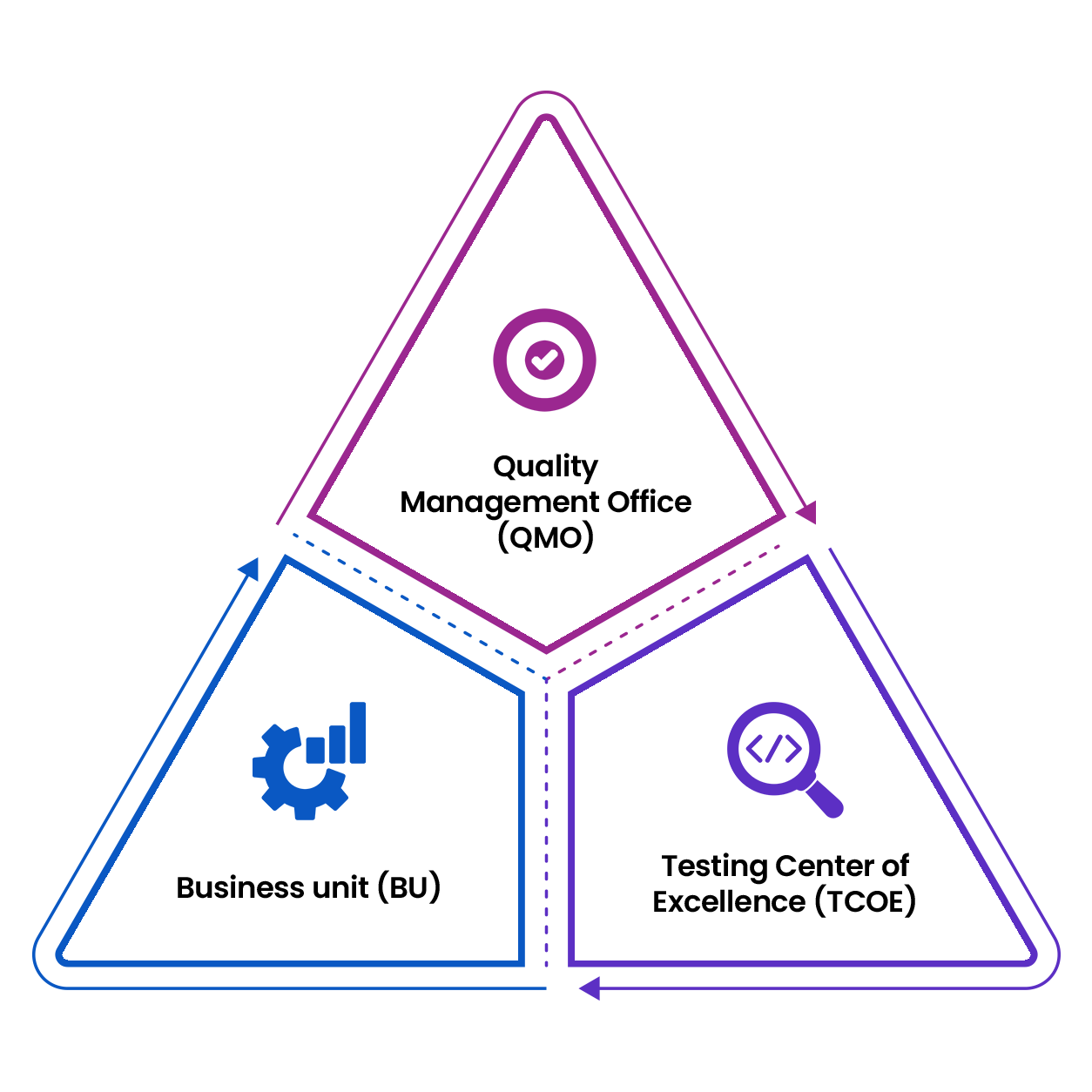
In many organizations, QA happens in silos—different teams use different standards, leading to inconsistent quality and fractured reporting. A Quality Management Office is designed to unify these efforts through a dedicated system of checks and balances.
The QMO remains structurally separate from delivery teams to ensure its health checks are objective and focused exclusively on the long-term maturity of your practice. By owning the standards, KPI definitions, and metrics catalogs, the QMO ensures that every project adheres to a unified, auditable playbook.
Closing the Executive Quality Gap
Inconsistent processes are a silent growth-killer. When reporting is not uniform, you lose the ability to measure success accurately, leading to a maturity plateau where teams prioritize speed over standards. Without a unified baseline for quality metrics, it is difficult to scale effectively.
The QMO closes this gap by providing full life cycle assurance. It conducts regular, independent audits across the full test life cycle to detect systemic gaps early. It validates that proposed solutions align with delivery reality and enforces evidence-driven discipline for project sign-offs. This results in 100% compliance with reporting frameworks, allowing for accurate capacity planning and smarter budget allocation.
Evidence in Action
The strategic value of a QMO is best demonstrated through real-world performance metrics. In a recent four-month engagement with a fintech company, Stratpoint embedded QMO governance into a testing-as-a-service (TaaS) model for high-complexity web platform testing.
The results demonstrated a significant reduction in the cost of quality:

This demonstrates the high throughput and predictable velocity achieved when a QMO-governed framework stabilizes the engineering life cycle.

This confirms our claim that uniform standards lower the total cost of quality by ensuring execution is correct the first time.

Even with high-complexity web platform testing, the QMO ensures institutional trust is maintained, eliminating the cycle of re-testing that stalls release velocity.
Standardizing for the Agentic Future
As we move toward agentic transformation, the importance of governance only grows. You wouldn’t put a high-performance AI engine in a car with a broken chassis; a QMO builds the chassis. Autonomous AI agents are only as capable as the environment they interact with, requiring a clean, governed engine of data and processes to function reliably.
A QMO ensures your engineering ecosystem is standardized and auditable, ensuring your organization is ready to scale autonomous operations tomorrow without sacrificing security or compliance.
Is your quality practice ready to scale from informal checks to institutional trust? Don’t leave your engineering excellence to chance.
Transition from manual oversight to an AI-ready quality engine. Book your QMO strategy session with #StratpointQA experts by filling out the form below.