
Key Takeaways
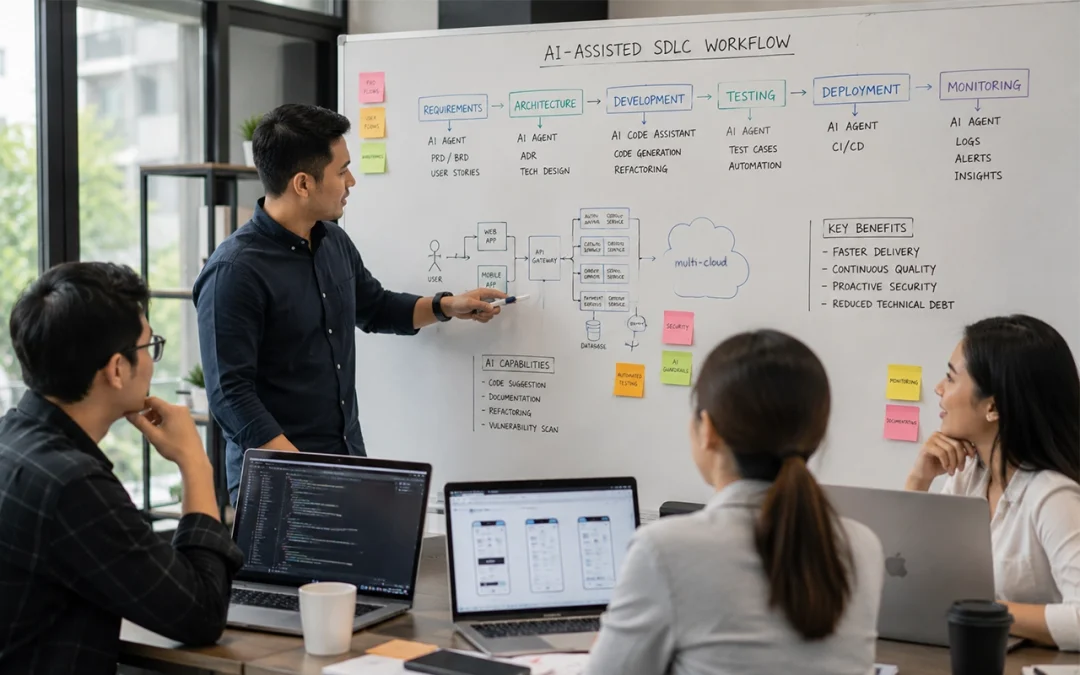
- The Reality of AI Generation: Generating code represents only a fraction of the software engineering lifecycle; building structurally sound systems requires a musculoskeletal frame—a human-centric engineering foundation.
- The Golden Path to Production: Harmonizing platform engineering and AI-augmented coding is essential for reducing developer cognitive load and enabling automated, secure deployment pathways.
- The Accountability Shift in QA: With AI-generated code, quality engineering has evolved from transactional, post-development inspection to continuous intent validation.
- The Synergy of Muscular Execution: True agentic transformation requires motor-control coordination–balancing the raw force of autonomous agents, the rapid reflexes of self-healing test suites, and the steady guidance of human engineers.
This blog marks the final chapter of our Digital Organism Series, where we have previously mapped the journey from chat to action with an accountable AI brain (Part 1), cured digital osteoporosis with a robust data skeleton (Part 2), and designed an AX-forward, reflexive cloud nervous system (Part 3). Now, we examine the physical execution layer—the muscles.
In the journey of agentic transformation, AI alone doesn’t ship enterprise products. Engineers do.
The gap between a compelling AI demo and a resilient, revenue-generating enterprise system remains a challenge for modern organizations. Many organizations fall into the trap of vibe-coding—relying on raw LLM prompts or standalone code assistants to stitch together a solution. But a cognitive brain without a physical body is just a puddle. While GenAI models can generate prototypes in minutes, turning these experimental concepts into stable software architectures requires the precision of seasoned engineering and rigorous QA.
At Stratpoint, we call software engineering and QA the muscles of the digital organism. While the AI brain handles reasoning and intent detection, it is the human-centric engineering foundation that translates those cognitive thoughts into precise, revenue-generating actions. In the digital enterprise, if GenAI is the brain firing off impulses, software and quality engineering are the muscles that convert those signals into mechanical, real-world force. This muscle is critical, as Gartner estimates that by 2027, 60% of organizations will fail to meet their expectations for AI initiatives due to ineffective governance.
Standardizing Agentic Transformation with Platform Engineering and AI-Augmented Coding
The contemporary software development landscape is increasingly defined by two parallel trends: platform engineering and AI-augmented coding. When integrated correctly, these disciplines create a highly efficient ecosystem that reduces the cognitive load on developers and establishes a standardized golden path to production. Internal developer platforms abstract the complexities of infrastructure management, allowing engineering teams to focus on system design and business logic rather than environment configuration.
However, the rapid acceleration of AI-augmented development has introduced unprecedented volume and complexity into codebases. Over 40% of modern enterprise codebase generation is driven by AI systems. While this shift dramatically accelerates initial output, the downstream implications on system health are severe. AI-generated code may contain structural errors, security flaws, or architectural inconsistencies that require direct human intervention.
Internal Developer Platform
(Secures Governance & Compliance)
AI-Augmented Coding
(Accelerates Velocity & Volume)
Continuous Quality Engineering
(Mitigates Error/Drift Rate)
Consequently, the role of QA has undergone a fundamental transformation. No longer treated as a late-stage gatekeeper, QA has emerged as an active accountability layer integrated directly into the engineering pipeline. Modern quality engineering demands a continuous validation discipline, transitioning from a reactive inspection model to a proactive quality by design approach. This ensures that as code output increases exponentially, the underlying structural integrity of the application remains uncompromised.
Evolving Modern Execution for Sustainable Agentic Transformation
As organizations navigate the journey toward agentic transformation and to sustain a healthy digital organism, the physical execution layer must develop complex motor control—coordinating both human intent and autonomous machine logic. This modern delivery paradigm rests on three core pillars:
- QA as an intent validator: In an agentic ecosystem, QA engineers must validate not just whether a button clicks, but whether an autonomous agent acts within corporate policy, regulatory boundaries, and defined business rules. This shifts testing from static inputs/outputs to validating complex agentic intent. Proactive intent validation is the ultimate defense against catastrophic compliance violations, unvetted transaction errors, and systemic operational risk.
- Self-healing test suites: Modern QA deploys automated, context-aware tests that dynamically adapt based on live user behaviors, UI element changes, and real-time error trends. This reduces manual script maintenance overhead and ensures testing pipelines remain uninterrupted, eliminating manual bottlenecks while accelerating time-to-market.
- Human+AI composition: Achieving system reliability requires recognizing where AI excels and where human oversight remains irreplaceable. While autonomous agents efficiently handle pattern recognition, synthetic data generation, and rapid test execution, true enterprise-grade systems are built when experienced developers orchestrate these tools, driving the architecture forward with strategic oversight. Grounding AI with certified human engineers ensures that rapid output is translated into stable, enterprise-grade architecture rather than high-liability technical debt.
The table below highlights this critical shift in execution:





The transition demonstrates that execution is the primary differentiator between organizations maintaining static prototypes and those delivering dynamic, production-grade applications. Transitioning from manual execution to automated, intent-based validation allows modern engineering teams to ship secure, reliable software at an accelerated pace.
Strategic Engineering for Production-Ready AI
Ultimately, an AI agent is only as reliable as the platform on which it operates. Organizations that treat generative models as standalone solutions often find their initiatives confined to internal sandboxes and non-critical workflows. Realizing the full potential of an enterprise-wide agentic transformation requires building a highly disciplined software engineering and QA framework. The competitive edge today is defined not by the size of your AI brain, but by the tone and strength of your engineering muscle.
By pairing automation with human oversight, enterprises can establish a closed-loop muscle engine where autonomous processes execute repetitive workflows while human engineers guide architecture, security, and governance. This balanced approach transforms AI from a highly variable experiment into a predictable, scalable business asset.
Download the Agentic Transformation Report to learn how modern software engineering and QA muscles turn raw AI capability into dependable production systems. Talk to our experts about evaluating your agentic readiness.